|
|
||||
|
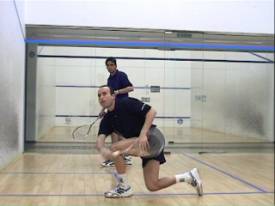
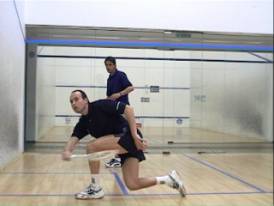
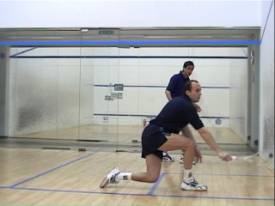
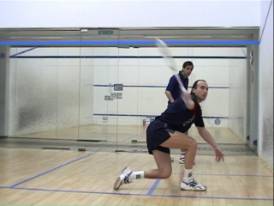
HOW TO HIT A BALL THAT IS GLUED TO THE SIDE WALL |
||||
|
|
||||
|
Sending the ball very close
to the sidewall, time and time again, is a trademark of professional squash.
However, even experienced club players are quite capable of doing almost the
same, even though less frequently. Therefore, every player, from beginner to
advanced, experiences close encounters of the solid kind! Beginners are faced
with a problem, which they have not encountered in any other racket sport.
They may be having a hard enough challenge when hitting a loose shot, let
alone a ball that is glued to the sidewall. More advanced players find
themselves playing against those who can send the ball close to the side,
with greater consistency. Such players would be looking for a high rate of success,
rather than a hit or miss technique. |
||||
|
|
||||
|
So, which are the most
important tips to consider, in order to obtain the highest rates of success?
Apart from assuring that the player has a good basic technique, which allows
considerable racket control, a couple of other points must be referred to.
Balance is extremely important. The player must not be anxious to pounce onto
the ball immediately, but rather, feel his position and sound weight
distribution on the legs. Balance is critical because the player’s head must
remain perfectly still during the swing. A lot can be learnt from the
techniques which golfers use. The player must also remain far away from the
sidewall, to allow room for an extended arm and racket. |
||||
|
|
||||
|
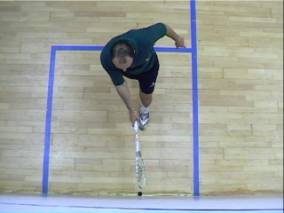
An important error to avoid
is that of taking the ball too early or in line with the left foot. Many
consider this – ball in line with the left foot (forehand)- to be the ideal
point of impact. However, this is not true, as shall be considered below. In
fact, the ball should be struck early only if it is momentarily detached from
the sidewall and is about to become closer and closer as it moves along.
Presuming that the ball is travelling parallel to the sidewall, delaying the
shot to a point of impact in line with the shoulder, would be ideal. |
||||
|
|
||||
|
|
|
|
|
|
|
|
|
|
|
|
|
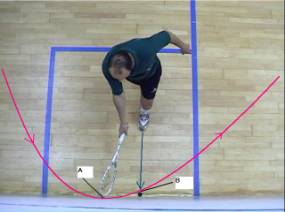
If
the player decides to strike the ball in line with the left foot (green
arrow), this photo illustrates the disadvantages. At point “A”, the maximum
radius of the swing could well produce contact between the racket and wall.
Even if such contact is avoided, at point “B”, the racket is already moving
away from the ball. That is, the player may miss the ball, or send it towards
the middle of the court. |
|
|
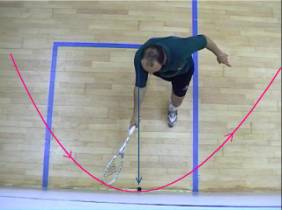
The
photo above, illustrates how, at the intended point of impact (in line with
the left foot), the racket follows its natural path and moves away from the
ball. |
|
|
|
||||
|
|
|
|
|
|
|
|
|
|
|
|
|
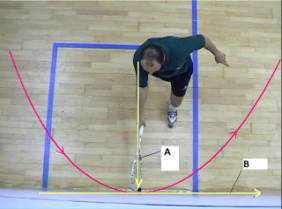
Delaying
the point of impact makes perfect sense. When the ball is in line with the
shoulder, the arc produced by the swing, radius (green arrow), and ball,
coincide. |
|
|
When
the ball is struck at point “A”, it should travel perfectly down the wall.
The arrow “B” represents the ball’s ideal path down the wall. This arrow is
the tangent to the circle created by the swing, and is at a 90° angle to the
radius “A”. |
|
|
|
||||
|
|
||||
|
|
||||
|
|
||||
CONCEPTS TO BE CONCIDERED
|
||||
|
|
||||
|
The above
descriptions of the forehand and backhand provided a detailed breakdown of
the strokes. However, understanding a few
concepts about the technique involved would help both players and coaches
improve the shots. |
||||
|
|
||||
|
I had
previously mentioned that most players feel lack of power on the backhand. To
overcome this difficulty, players must understand the importance of
acceleration, speed, co-ordination, relaxation, and balance, and then try to
apply this knowledge not just to hit the ball harder on the backhand, but
also to achieve maximum power with least effort, when required. |
||||
|
|
||||
|
ACCELARATION |
||||
|
|
||||
|
the racket head speed, the more powerful the shot produced as
there is good impact with the ball. Remember though that at the beginning of
the swing, the racket is still, or moving at 0 meters per second and will
definitely not reach its maximum speed suddenly, but will rather build up
speed to get to its maximum. So remember, there is no point in forcing
things. |
||||
|
|
||||
|
The human
body and our muscles are unable to neither produce maximum power in a tiny
fraction of a second nor keep up this level forever. Therefore, when the ball
is struck, we must assure that the racket head has built up to maximum speed
and does not slow down too early, otherwise our efforts would be in vain. |
||||
|
|
||||
|
SPEED |
||||
|
|
||||
|
that the tip of the racket is the fastest moving part. It also
has more leverage. Being the most distant point from the axis, the tip of the
racket develops the greatest speed, and the further away, from the body, the
greater the speed. Hence, a large swing, at a good distance from the body,
will generate more speed. |
||||
|
|
||||
|
CO-ORDINATION |
||||
|
|
||||
|
, any effort would be absolutely useless. Unfortunately, we take
co-ordination for granted, but those unlucky enough to remain in plaster or
in bed for a long period of time, realise that walking is not so simple.
Also, running without bending the knees with accuracy and timing leads to
less efficiency. Talented runners do not have this problem. Seeing the
fluidity of Carl Lewis in action was proof. In producing complex movements,
proper co-ordination is harder to identify and appreciate its importance. The
racket swing, especially on the forehand is quite complex, and many muscle
groups are involved. If a player were unable to contract the right muscle
fibres at the right time, it would be impossible to develop the desired
racket speed or have sufficient control. |
||||
|
|
||||
|
RELAXATION |
||||
|
|
||||
|
to co-ordination and is fundamental in making the right
muscle work efficiently at the right moment. The human body is made up of
opposing muscle groups. For example, muscles to bend the legs, while others
to extend them. The abdominal muscles to bend forwards, while the lower back
muscles to bend backwards. If opposing muscles contract at the same moment
with equal intensity, there would be no movement. Less obviously but much
more common is the case of an antagonist muscle that is slightly flexed while
the principle muscle is at work. This would result in reduced sensitivity and
a large degree of wasted energy. |
||||
|
|
||||
|
Hence, when
learning technique, the racket must not be gripped too firmly, and the player
must not try to hit the ball hard. He should try to relax and be smooth,
while feeling his muscles work. In other words, the right muscles should be
working at the right time, and the player should try to feel which muscles
should be active and which should be relaxed. |
||||
|
|
||||
|
BALANCE |
||||
|
|
||||
|
seeing any sportsman or woman produce a sound action without maintaining good
balance. Even a goalkeeper maintains his sense of balance while diving in the
air. It is more obvious in the case of a squash player. Good balance goes
hand in hand with control. It is also important to note that if a player
loses his balance, he may regain it by using certain muscles to push his body
back into position. The problem arises when the muscles involved hinder the
primary muscles that are at work to produce the desired action. To make
things clearer, imagine a player who bends over too much to reach the ball
and loses his balance; then tries to recover by straightening his back. At this point his lower back muscles are working hard
and will hinder free rotation as he takes his swing. More will be said about
this subject in the section on dynamic equilibrium. |
||||
|
|
||||
|
|
||||
PUTTING THE ELEMENTS TOGETHER
|
||||
|
|
||||
|
The technique
that has been explained above is composed of various individual movements put
together in a precise sequence. Different joints and numerous muscles take
part in the action. The role played by each of these, has its own great
importance, but no single muscle or joint is sufficient to produce an
effective shot. This shall be demonstrated below, to help explain how these
various components contribute towards the resulting shot. |
||||
|
|
||||
|
Let us first
make the assumption that hitting the ball very hard is equivalent to
effortlessly hitting a medium paced shot. When trying to send the ball fast
down the full length of the court, our goal is to use a technique, which
permits minimal energy input, but produces maximum output. This is important
because when playing a game, the vast majority of our energy should be
dedicated to court coverage. |
||||
|
|
||||
|
When striking
the ball, there is mobility at the waist, and the joints involved are those
of the shoulder, elbow, and wrist. What would happen if the ball is struck by
using only |
||||
|
|
||||
|
Looking more
closely at the components which have been separated in the clips above, a few
interesting points can be seen. Remember that our objective is to have the
racket head moving at maximum speed on impact- with some weight behind the
ball- and that the maximum speed will only be attained through acceleration.
When the ball is hit by using only the shoulders, the speed of the racket is
low and the weight behind the shot is moderate. When only the elbow is used,
racket speed increases but the weight behind the ball declines. When only the
wrist is used, racket speed is at its maximum compared to all the other
examples, but the weight is at a minimum. When using only the upper body
through torsion at the waist, the racket speed is moderate but the weight
behind the shot is greatest. In the last example where the feet do not
provide anchorage or stability, most of the energy input is not transferred
onto the ball and is hence, the least effective of actions. In fact, this is
the only component, which should not be incorporated into sound technique. |
||||
|
|
||||
|
Recalling
what has been explained about the forehand in a previous section, we can now
see how the individual elements described above, fit in. The first movement
is fairly slow as the shoulders begin to rotate. Almost at the same time
there is movement at the shoulder joint as the frontal shoulder muscles and
pectoral muscles begin to contract, bringing the elbow forward. During the
next phase, the triceps are at work, gradually straightening the arm. After
which, the flexor muscles of the forearm contract and the wrist comes into
action, bringing in the racket head forward even faster. |
||||
|
|
||||
|
On impact the
player has managed to sum up and multiply the forces and speeds. The action
had started relatively slow and far away from the racket head and had little
influence regarding its speed, then gradually the muscles and joints put to
work got closer and closer to the racket, and had a more important effect on
its movement. The tip of the racket started off close to the body and
gradually moved further away, tracing an arc with an increasing radius, hence,
contributing to speed and power. |
||||
|
|
||||
|
Now let’s get
back to the action. As mentioned before, the shot does not by any means end
on impact. The follow-through is fundamental as the racket head must at least
maintain its speed if not continue to accelerate before it starts its
deceleration. A shot without a follow- through or with an abrupt ending
would imply that opposing muscles
have been called in to act as breaks. A short follow-through would bring in
the breaks too early and slow down the shot itself. There would also be
excessive energy expenditure. |
||||
|
|
||||
|
At this
point, it is quite obvious that without precise co-ordination, the shot could
not be executed well. Imagine beginning the shot by first moving the wrist,
elbow, and then finally shoulder joint. The result would be a shot that would
just about make it to the front wall. If the muscles work at the wrong time,
the swing would be impeded. |
||||
|
|
||||
|
Relaxation is
also fundamental. Just think of what would happen if the rear shoulder
muscles, biceps, and forearm extensors got into the action because the player
is tense and fails to relax, or thinks that the more muscle power piled up
into the movement, the more powerful the shot. Now think of those less
experienced players who use their legs and lower back muscles while swinging.
This is very noticeable when you see them push off with the legs and lose
their balance too. Use of the lower body will lead to greater wasted effort
and will slow down the shot. (Even worse, it will hinder accuracy and
movement back to the T.) |
||||
|
|
||||
|
Therefore, balance and
stability are vital to keep the feet in their place. While relaxation and the use of the right
muscles is our guide towards perfecting any particular movement. Every muscle
and joint must be employed in the right way and at the right time. |
||||
|
|
||||
|
|
||||
|
|
||||
|
|
||||
MAKE SURE YOU’VE GOT IT RIGHT ,
|
||||
|
|
||||
|
I would
give the following advise to coaches
and players. A beginner who wants to get his technique right or an advanced
player who is not satisfied with his technique should try this. |
||||
|
|
||||
|
Let us first make it clear that it is
vital to be able to hit the ball with an open racket face, and be able to
slice the ball when required. |
||||
|
|
||||
|
A couple of
simple exercises would verify if the player is using his racket properly, and
if not, force him to do so. |
||||
|
|
||||
|
Start at the
front of the court, very close to the front wall. The ball is set up by the
player, if there is no one available to feed. If the player is a beginner, it
is strongly advisable to have a coach setting up the ball and assisting. The
player must then try to open the racket face as much as possible and hit the
ball upward, aiming for the out-of-court line on the front wall. In other
words, attempting to produce an extremely high lob. |
||||
|
|
||||
|
After feeling comfortable with that,
the player should go back to hitting the ball down the wall with an open
racket face. |
||||
|
|
||||
|
Another exercise
which forces correct technique is that of volleying the ball down the wall.
The point of impact must however, be at knee height or lower. It would be
best to have the coach or partner set up this shot. Follow the video
illustration to have a clear understanding of how this exercise should be
carried out. Starting off
with the forehand, this |
||||
|
|
||||
|
|
|
|
|
|
|
|
||||
|
|
||||
|
On the backhand, any player
who doesn't manage to get the arm moving under the ball will realise the
importance of this key jest when he
affronts this shot. It is clear how the player finds the shot very difficult
when executed with a closed racket face, as in this |
||||
|
|
||||
|
|
|
|
|
|
|
Apart
from losing power and inability to lift the ball, the arm moving upwards on
the follow-through (instead of moving up and across the body) forces the
right leg to work harder when pushing back towards the T. |
||||
|
|
||||
|
|
|
|
|
|
|
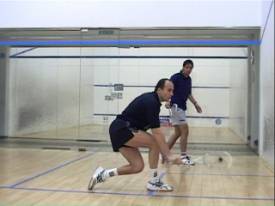
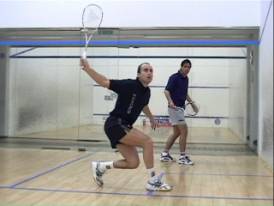
This
is not the case in the two photos above, demonstrating correct technique. The
racket face is well open, and the ball is struck cleanly. The resulting shot
can be powerful or lifted high onto the front wall with ease. The follow-through
in the correct direction unloads the weight off the right leg and returning
to the T is made simple. |
||||
|
|
||||
|
|
||||
|
|
||||